Finding A Good Therapist Is Hard: Here's why.
Ultimately, a therapist's trainings, theory, experience and skills are useless if you don't like them.

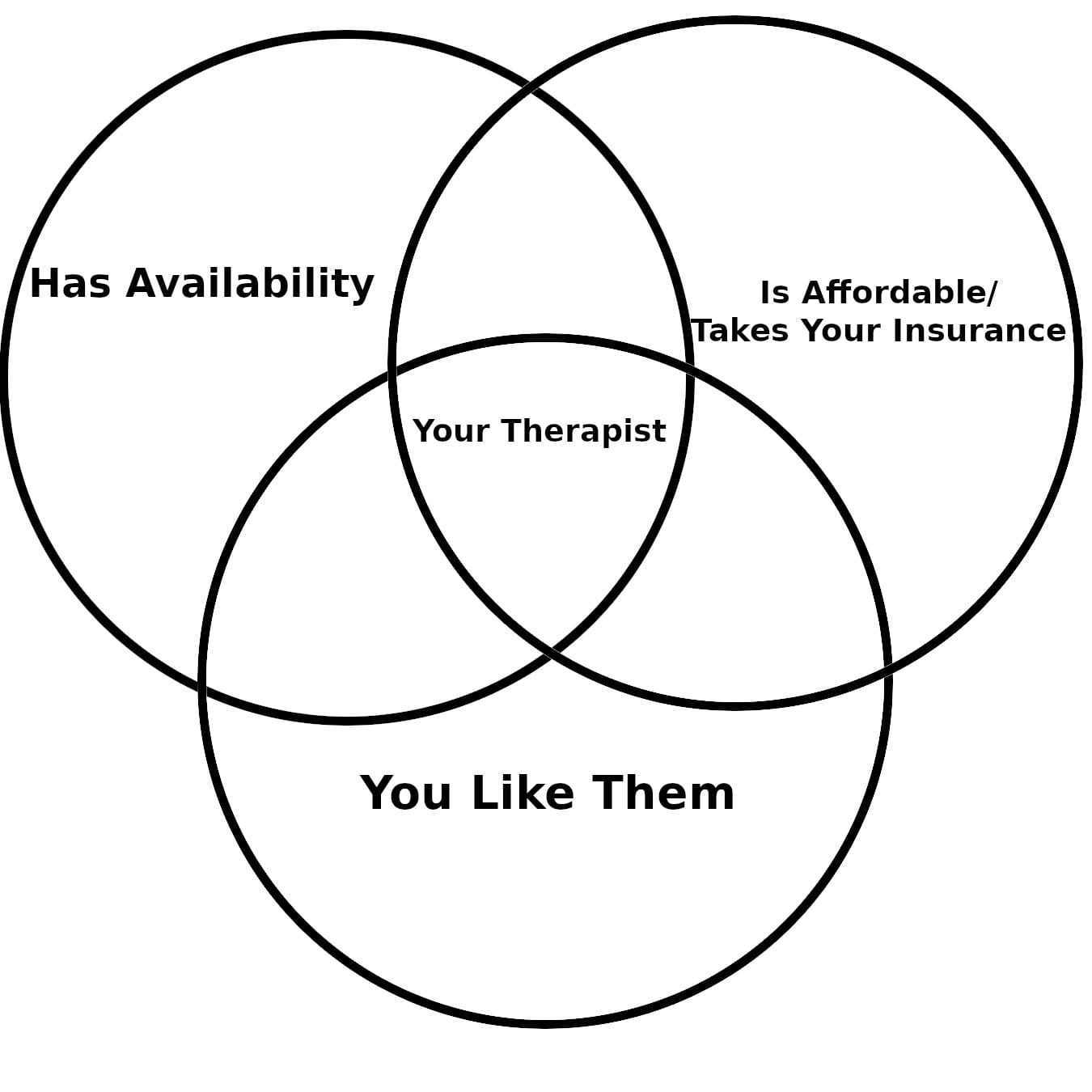
"Go to therapy" is the solution offered for so many issues. It's wonderful that therapy is much more mainstream and accessible than it was 20 years ago. Unfortunately, it is incredibly difficult to find a therapist who has availability, accepts your insurance/is affordable, is competent in the area in which you need support and that you actually like.
Here's the insider's take on why it's so hard to find a therapist, and some strategies to help you in your search.
Limited Availabilty
Like a doctor, therapists are limited in the number of clients they can reasonably have on their caseload. Unlike a doctor, who is often scheduled in 15-20 minute appointments, and you may see them once or twice a year, therapy is usually 45 to 60 minutes weekly or every other week. (The "therapy hour" being 50 minutes is pretty standard.) Over the course of a 40 hour work week, most master's level therapists (LCSW, LMHC, LPC) will have space to see between 20 and 30 clients. The rest of that time is spent on administrative tasks, and necessary breaks. In order to accomodate weekly and bi-weekly appointments, private practice therapists cap their caseload at around 40. Some therapists have much smaller caseloads due to a variety of factors.
Carrying caseloads much above 40 leads to big gaps between sessions, up to a month. This is common in many community mental health clinics. At one point when I was a school-based therapist I had 80 clients on my caseload, and I saw many of them only for 30 minutes per session. The gap between initial session and followup was sometimes a month long. It wasn't good for the clients, and it wasn't good for me as a clinician either. High caseloads and minimal rest mean that providers burn out and leave, not just that clinic, but sometimes clinical work entirely. So for longevity, we put a cap on what feels manageable for our daily and weekly schedules.
Insurance Headaches
Finding a therapist who accepts your insurance can feel impossible. So many therapists do not take insurance, partly because of the administrative headaches and restrictions placed on care, and partly because often reimbursement rates are insultingly low. I left a number of insurance panels after years of being consistently underpaid to the tune of 40% less than comparable plans. Frustratingly, out of network reimbursement rates are consistently higher for many plans, but clients must pay for the session first and then wait to be reimbursed.
There is also a consistent challenge of insurance companies listing someone as in-network who is not. One of the insurances I left last year still has not taken me off of the list of in-network providers. I have tried multiple times to rectify this, and I still have to disappoint prospective clients when I tell them the listing is incorrect. These "ghost networks" create headaches for prospective clients and clinicians, and are technically illegal. Unfortunately, there doesn't seem to be much anyone can do to change insurance company behavior.
Using insurance also forces the use of the medical model, which means diagnosing and demonstrating "medical necessity" for reimbursement. Some clients choose to private pay for the increased privacy and flexibility it gives them.
Cost
Therapy is different from talking to a trusted friend because, besides our training and expertise, clients are not expected to emotionally care for us while we are providing care. The exchange is, instead, that we get paid for our time and effort.
Out of pocket costs for therapy can be super challenging. "Therapy should be free!" say many proponents of therapy. I don't know of any other industry that skilled labor is expected to be free. As much as we would love to provide care for free, this is our job and we need to get paid appropriately for it somehow. I agree that it shouldn't be a luxury service though. All licensed therapists have a Master's degree at minimum, and consistently get paid less than registered nurses. On the flip side, I have many clients who struggle to afford a $15-$25 copay every week. In my area of upstate NY, the standard cash rate for 60 minutes of therapy is between $150 and $200. Policies like no-show or cancellation fees are not meant to be punitive, but to ensure that we still can pay our bills if someone cancels and we don't have time to fill the spot.
There are many therapists who don't make enough money to afford their own therapy, something which is a necessary part of caring for ourselves in this work. I promise you, very few therapists are taking home a six figure income. And those that are, often live and work in expensive areas, or are highly specialized.
Therapy Jargon is Weird
Once you've found a list of folks who have openings, take your insurance and are affordable, then you have to make a decision. How do you decide who is good? How do you decide who is good for you? There are so many acronyms and new words to consider. CBT, DBT, IFS, solution-focused, somatic, psychodynamic are all words you may see listed as approaches or styles a therapist uses.
Ultimately, a therapist's trainings, theory, experience and skills are useless if you don't like them. There is strong evidence that having a positive relationship with your therapist is more important than any other factor in whether or not therapy is effective for you. Someone could have a dozen letters after their name and be certified in 4 different specializations and still not be a good fit. It's also common to outgrow a therapist, where they used to be a good fit and then because of growth, change and circumstances they no longer are. That's normal.
Simplifying the Search Process
One of the highest honors therapists receive is a referral from a current or former client. However, because no two people are the same, the person who was great for person A is not a good fit for person B. Here are my recommendations for starting the therapy search process and things that can be helpful in making a decision.
-Decide if the gender of your therapist matters.
-Decide whether you want in-person or telehealth therapy.
-Consider what style of interaction you would like. Some therapists are very gentle and quiet, some are more direct. Do you want more of a hands-on problem solver, or space to explore your thoughts and feelings without a lot of intervention? (Pro-tip, if you're neurodivergent, you will likely do better with someone direct and hands-on.)
-If you are using insurance, search for therapists in your area who are accepting new clients on the insurance website, and save the list
-Take that list and search for each name on the list. Many therapists advertise on PsychologyToday. Read their bio, see if the way they say they approach therapy feels like a good fit. If you want a hands-on approach look for "solution focused", if you want more of a hands-off approach, look for psychodynamic and/or humanistic.
-Once you've narrowed your list from insurance with information from your search, then call or email each potential provider. They may or may not have openings depending on how full their schedule is. Their open sessions may or may not work with your work/life/family schedules.
-Set up an initial session and go. Feel it out. Ask lots of questions. Give yourself permission to not reschedule if it doesn't feel like the right fit.
It's a big process, but hopefully I've given you all some insight as to why it's so complicated and annoying.
Take good care of yourselves.